
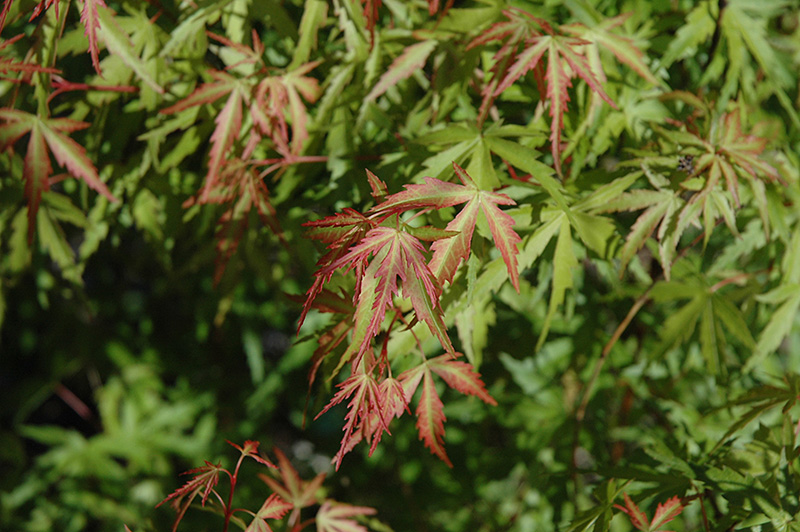
Garyu Dwarf Japanese Maple
Description
One of the most bizarre Japanese maples, this is a prostrate spreader that grows out more than up, will trail out of containers or along the ground; dazzling toothed foliage emerges red and turns fiery colors in fall; a dream plant for the rock garden
Landscape Attributes
Garyu Dwarf Japanese Maple is a multi-stemmed deciduous shrub with a ground-hugging habit of growth. It lends an extremely fine and delicate texture to the landscape composition which should be used to full effect.
Garyu Dwarf Japanese Maple is recommended for the following landscape applications;
Planting & Growing
Garyu Dwarf Japanese Maple will grow to be about 3 feet tall at maturity, with a spread of 4 feet. It has a low canopy with a typical clearance of 1 foot from the ground. It grows at a slow rate, and under ideal conditions can be expected to live for 60 years or more.
This shrub does best in full sun to partial shade. You may want to keep it away from hot, dry locations that receive direct afternoon sun or which get reflected sunlight, such as against the south side of a white wall. It prefers to grow in average to moist conditions, and shouldn't be allowed to dry out. It is not particular as to soil pH, but grows best in rich soils. It is somewhat tolerant of urban pollution, and will benefit from being planted in a relatively sheltered location. Consider applying a thick mulch around the root zone in winter to protect it in exposed locations or colder microclimates. This is a selected variety of a species not originally from North America.
Garyu Dwarf Japanese Maple makes a fine choice for the outdoor landscape, but it is also well-suited for use in outdoor pots and containers. Because of its spreading habit of growth, it is ideally suited for use as a 'spiller' in the 'spiller-thriller-filler' container combination; plant it near the edges where it can spill gracefully over the pot. It is even sizeable enough that it can be grown alone in a suitable container. Note that when grown in a container, it may not perform exactly as indicated on the tag - this is to be expected. Also note that when growing plants in outdoor containers and baskets, they may require more frequent waterings than they would in the yard or garden. Be aware that in our climate, this plant may be too tender to survive the winter if left outdoors in a container. Contact our experts for more information on how to protect it over the winter months.