
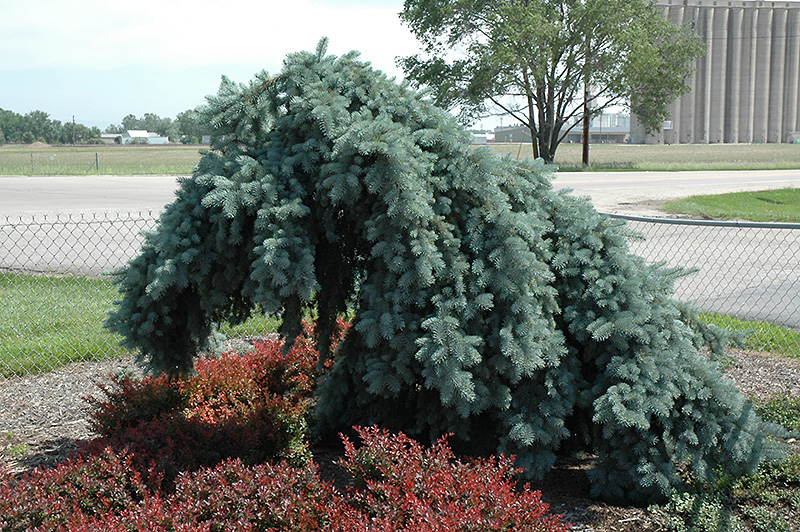
Weeping Blue Spruce
Description
A weeping and trailing spire-like tree, with dusty blue pointy needles held on sharply trailing branches, almost skirted in appearance; durable and very hardy, a most emphatic accent tree to say the least
Landscape Attributes
Weeping Blue Spruce is a dense evergreen dwarf tree with a strong central leader and a shapely form and gracefully arching branches. Its relatively fine texture sets it apart from other landscape plants with less refined foliage.
Weeping Blue Spruce is ideal for use as a garden accent or patio feature, and is recommended for the following landscape applications;
Planting & Growing
Weeping Blue Spruce will grow to be about 10 feet tall at maturity, with a spread of 5 feet. It tends to be a little leggy, with a typical clearance of 1 foot from the ground, and is suitable for planting under power lines. It grows at a slow rate, and under ideal conditions can be expected to live for 70 years or more.
This dwarf tree should only be grown in full sunlight. It is very adaptable to both dry and moist growing conditions, but will not tolerate any standing water. It is considered to be drought-tolerant, and thus makes an ideal choice for xeriscaping or the moisture-conserving landscape. It is not particular as to soil type or pH, and is able to handle environmental salt. It is highly tolerant of urban pollution and will even thrive in inner city environments. This is a selection of a native North American species.
Weeping Blue Spruce is a fine choice for the yard, but it is also a good selection for planting in outdoor pots and containers. Because of its height, it is often used as a 'thriller' in the 'spiller-thriller-filler' container combination; plant it near the center of the pot, surrounded by smaller plants and those that spill over the edges. It is even sizeable enough that it can be grown alone in a suitable container. Note that when grown in a container, it may not perform exactly as indicated on the tag - this is to be expected. Also note that when growing plants in outdoor containers and baskets, they may require more frequent waterings than they would in the yard or garden.