
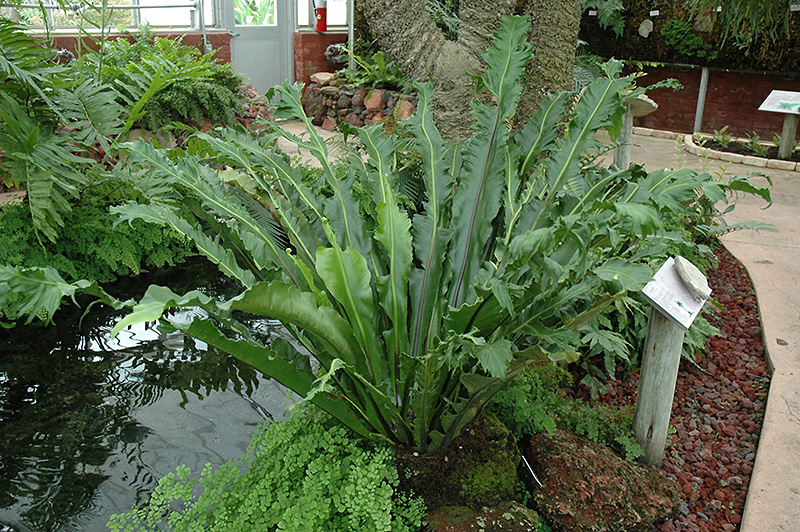
Japanese Nest Fern
Description
This sterile variety produces long lobed and twisted fronds from a loose rosette, that gracefully arch into a vase shape; requires high moisture; great as a pondside accent, but can also be maintained in containers; prefers light shade
Landscape Attributes
Japanese Nest Fern is an herbaceous annual with a more or less rounded form. Its wonderfully bold, coarse texture can be very effective in a balanced garden composition.
Japanese Nest Fern is recommended for the following landscape applications;
Planting & Growing
Japanese Nest Fern will grow to be about 4 feet tall at maturity, with a spread of 4 feet. Its foliage tends to remain dense right to the ground, not requiring facer plants in front. Although it's not a true annual, this slow-growing plant can be expected to behave as an annual in our climate if left outdoors over the winter, usually needing replacement the following year. As such, gardeners should take into consideration that it will perform differently than it would in its native habitat.
This plant does best in partial shade to shade. It prefers to grow in moist to wet soil, and will even tolerate some standing water. It is particular about its soil conditions, with a strong preference for rich, acidic soils. It is somewhat tolerant of urban pollution, and will benefit from being planted in a relatively sheltered location. Consider applying a thick mulch around the root zone over the growing season to conserve soil moisture. This species is not originally from North America, and parts of it are known to be toxic to humans and animals, so care should be exercised in planting it around children and pets. It can be propagated by division.
Japanese Nest Fern is a fine choice for the garden, but it is also a good selection for planting in outdoor pots and containers. Because of its height, it is often used as a 'thriller' in the 'spiller-thriller-filler' container combination; plant it near the center of the pot, surrounded by smaller plants and those that spill over the edges. It is even sizeable enough that it can be grown alone in a suitable container. Note that when growing plants in outdoor containers and baskets, they may require more frequent waterings than they would in the yard or garden.