
Dash Pink Pinks
Description
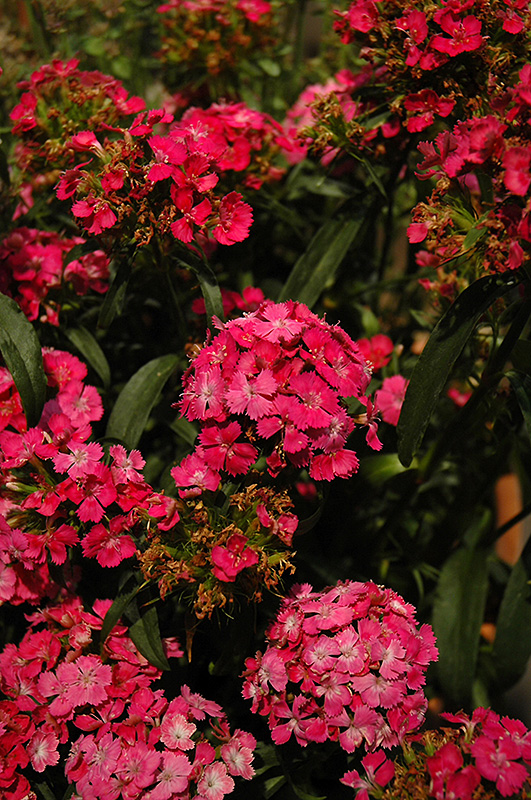
Deliciously clove-scented, velvety frilly pink flowers; compact, uniform, and well branched; optimal site has full sun with ample moisture; amend clay soils for best growth; seeds freely but divide for truest color
Landscape Attributes
Dash Pink Pinks is an herbaceous evergreen perennial with an upright spreading habit of growth. It brings an extremely fine and delicate texture to the garden composition and should be used to full effect.
Dash Pink Pinks is recommended for the following landscape applications;
Planting & Growing
Dash Pink Pinks will grow to be about 15 inches tall at maturity extending to 20 inches tall with the flowers, with a spread of 15 inches. When grown in masses or used as a bedding plant, individual plants should be spaced approximately 12 inches apart. Its foliage tends to remain dense right to the ground, not requiring facer plants in front. It grows at a medium rate, and tends to be biennial, meaning that it puts on vegetative growth the first year, flowers the second, and then dies. As an evegreen perennial, this plant will typically keep its form and foliage year-round.
This plant should only be grown in full sunlight. It prefers to grow in average to moist conditions, and shouldn't be allowed to dry out. It is not particular as to soil type or pH. It is highly tolerant of urban pollution and will even thrive in inner city environments. This particular variety is an interspecific hybrid. It can be propagated by division; however, as a cultivated variety, be aware that it may be subject to certain restrictions or prohibitions on propagation.
Dash Pink Pinks is a fine choice for the garden, but it is also a good selection for planting in outdoor pots and containers. With its upright habit of growth, it is best suited for use as a 'thriller' in the 'spiller-thriller-filler' container combination; plant it near the center of the pot, surrounded by smaller plants and those that spill over the edges. Note that when growing plants in outdoor containers and baskets, they may require more frequent waterings than they would in the yard or garden.