
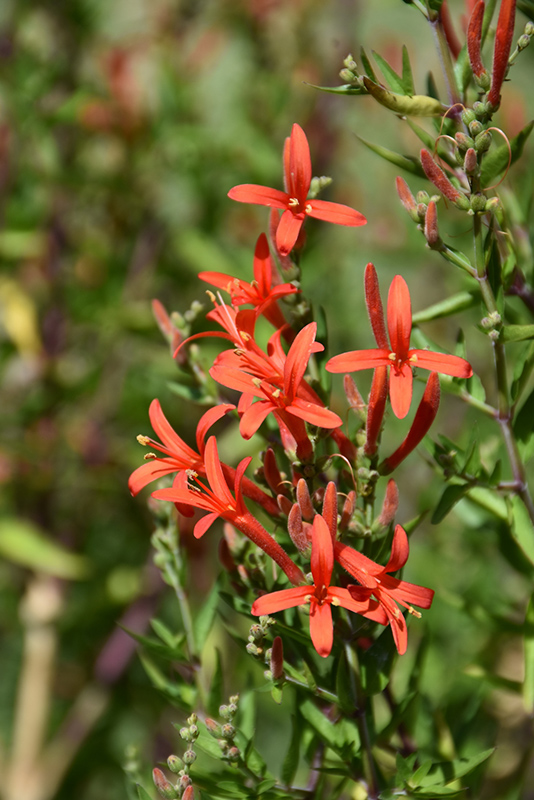
Flame Acanthus
Description
A beautiful native shrub of south central Texas, producing vivid red-orange tubular flowers from late spring to fall; very adaptable and drought tolerant; great for heavy soils or growing in containers; a fine landscape specimen plant
Landscape Attributes
Flame Acanthus is a multi-stemmed perennial with a mounded form. Its relatively fine texture sets it apart from other garden plants with less refined foliage.
Flame Acanthus is recommended for the following landscape applications;
Planting & Growing
Flame Acanthus will grow to be about 5 feet tall at maturity, with a spread of 4 feet. Although it is technically a woody plant, this fast-growing plant can be expected to behave as a perennial in our climate if planted outdoors over the winter, usually regrowing from its base (crown) the following year. As such, gardeners should take into consideration that it will perform differently than it would in its native habitat.
This plant should only be grown in full sunlight. It prefers to grow in average to dry locations, and dislikes excessive moisture. It is considered to be drought-tolerant, and thus makes an ideal choice for a low-water garden or xeriscape application. It is not particular as to soil type or pH. It is highly tolerant of urban pollution and will even thrive in inner city environments. Consider applying a thick mulch around the root zone in winter to protect it in exposed locations or colder microclimates. This is a selection of a native North American species.; however, as a cultivated variety, be aware that it may be subject to certain restrictions or prohibitions on propagation.
Flame Acanthus is a fine choice for the garden, but it is also a good selection for planting in outdoor pots and containers. Because of its height, it is often used as a 'thriller' in the 'spiller-thriller-filler' container combination; plant it near the center of the pot, surrounded by smaller plants and those that spill over the edges. It is even sizeable enough that it can be grown alone in a suitable container. Note that when growing plants in outdoor containers and baskets, they may require more frequent waterings than they would in the yard or garden. Be aware that in our climate, this plant may be too tender to survive the winter if left outdoors in a container. Contact our experts for more information on how to protect it over the winter months.