
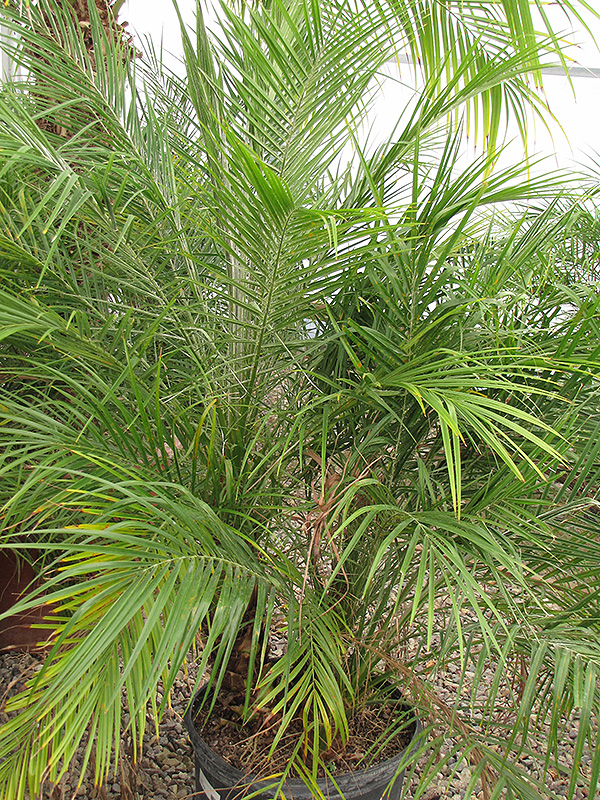
Pygmy Date Palm (shrub form)
Description
This miniature palm makes an incredible accent plant; cut suckers away to maintain a single trunk; will slowly mature into a compact palm to make an excellent focal point; great tropical accent for patio planters
Landscape Attributes
Pygmy Date Palm (shrub form) is a multi-stemmed deciduous shrub with a towering form, with a high canopy of foliage concentrated at the top of the plant. Its relatively fine texture sets it apart from other landscape plants with less refined foliage.
Pygmy Date Palm (shrub form) is recommended for the following landscape applications;
Planting & Growing
Pygmy Date Palm (shrub form) will grow to be about 6 feet tall at maturity, with a spread of 6 feet. It has a low canopy with a typical clearance of 2 feet from the ground, and is suitable for planting under power lines. It grows at a slow rate, and under ideal conditions can be expected to live for 60 years or more. This is a dioecious species, meaning that individual plants are either male or female. Only the females will produce fruit, and a male variety of the same species is required nearby as a pollinator.
This shrub does best in full sun to partial shade. It does best in average to evenly moist conditions, but will not tolerate standing water. It is not particular as to soil type or pH. It is somewhat tolerant of urban pollution. This species is not originally from North America.
Pygmy Date Palm (shrub form) makes a fine choice for the outdoor landscape, but it is also well-suited for use in outdoor pots and containers. Because of its height, it is often used as a 'thriller' in the 'spiller-thriller-filler' container combination; plant it near the center of the pot, surrounded by smaller plants and those that spill over the edges. It is even sizeable enough that it can be grown alone in a suitable container. Note that when grown in a container, it may not perform exactly as indicated on the tag - this is to be expected. Also note that when growing plants in outdoor containers and baskets, they may require more frequent waterings than they would in the yard or garden. Be aware that in our climate, this plant may be too tender to survive the winter if left outdoors in a container. Contact our experts for more information on how to protect it over the winter months.