
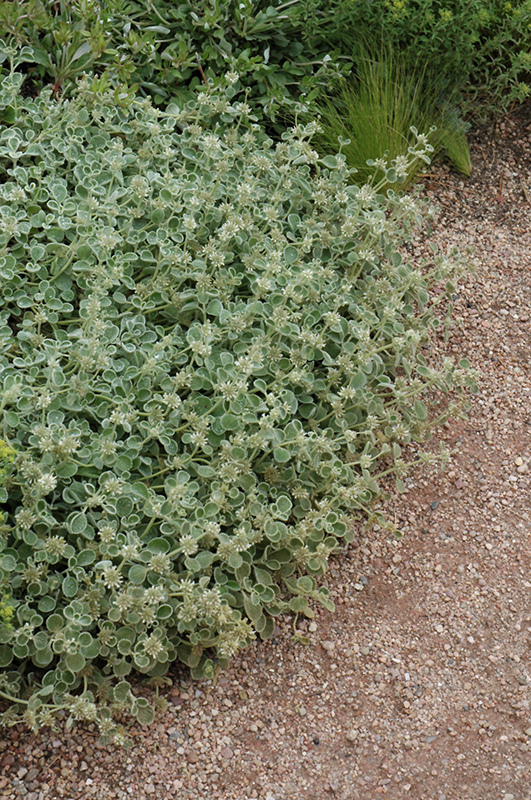
Silver Edged Horehound
Description
A fuzzy, mat forming perennial groundcover, with round, woolly sage-green leaves with silvery white edges and undersides; does well in poor soils and dry sunny sites; does not like humid, hot conditions;
Landscape Attributes
Silver Edged Horehound is a dense herbaceous perennial with a ground-hugging habit of growth. Its relatively fine texture sets it apart from other garden plants with less refined foliage.
Silver Edged Horehound is recommended for the following landscape applications;
Planting & Growing
Silver Edged Horehound will grow to be only 6 inches tall at maturity extending to 8 inches tall with the flowers, with a spread of 20 inches. When grown in masses or used as a bedding plant, individual plants should be spaced approximately 16 inches apart. Its foliage tends to remain low and dense right to the ground. It grows at a medium rate, and under ideal conditions can be expected to live for approximately 10 years. As an herbaceous perennial, this plant will usually die back to the crown each winter, and will regrow from the base each spring. Be careful not to disturb the crown in late winter when it may not be readily seen!
This plant should only be grown in full sunlight. It prefers dry to average moisture levels with very well-drained soil, and will often die in standing water. It is considered to be drought-tolerant, and thus makes an ideal choice for a low-water garden or xeriscape application. It is particular about its soil conditions, with a strong preference for sandy, acidic soils. It is somewhat tolerant of urban pollution. This species is not originally from North America..
Silver Edged Horehound is a fine choice for the garden, but it is also a good selection for planting in outdoor pots and containers. Because of its spreading habit of growth, it is ideally suited for use as a 'spiller' in the 'spiller-thriller-filler' container combination; plant it near the edges where it can spill gracefully over the pot. Note that when growing plants in outdoor containers and baskets, they may require more frequent waterings than they would in the yard or garden.